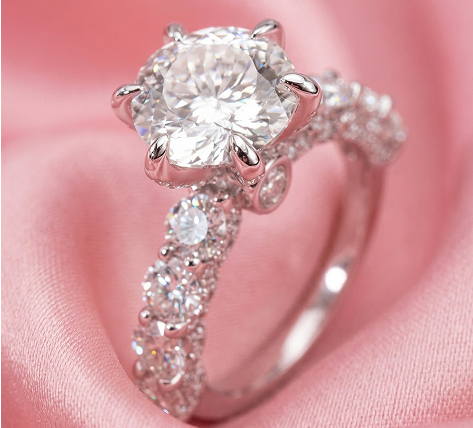
Blossom Cut Statement RingBlossom Cut Statement Ring

Moissanite vs Cubic Zirconia: What's the Difference?

If you're shopping for a diamond alternative, you've likely come across both moissanite and cubic zirconia. They're often mentioned in the same breath — but they're very different stones. Here's everything you need to know before you buy.

The Short Answer

Both moissanite and cubic zirconia are diamond alternatives, but that's roughly where the similarities end. Moissanite is a rare gemstone originally discovered in a meteor crater, now created in laboratories. It's one of the hardest substances on earth, has exceptional brilliance, and retains its sparkle for a lifetime. Cubic zirconia (CZ) is a synthetic material made from zirconium dioxide. It's inexpensive to produce, looks impressive when new, but scratches and clouds over time.

If you're looking for a stone to wear every day — particularly in a ring — the difference matters more than you might think.

"Moissanite isn't a substitute for something better. For many buyers, it simply is the better choice — more brilliant than diamond, more durable than CZ, and a fraction of the price of either."

How They Compare: The Key Differences

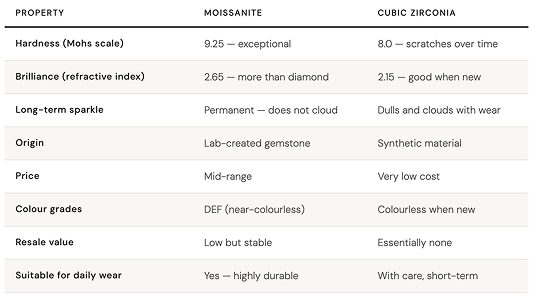
Here's a side-by-side look at how moissanite and cubic zirconia stack up across the metrics that actually matter:

Sparkle: Why Moissanite Actually Outshines Diamond

This is the detail that surprises most people. Moissanite has a higher refractive index than diamond — 2.65 versus diamond's 2.42 — which means it bends light more intensely and produces more fire (the coloured flashes you see as light moves through a stone). In direct sunlight or under bright lighting, a moissanite ring produces a rainbow-like dispersion that some people find even more beautiful than diamond.

Cubic zirconia, by contrast, has a refractive index of around 2.15. It sparkles when new — quite impressively, in fact — but that sparkle is more uniform and less complex than moissanite. And because CZ is much softer, the surface scratches with everyday contact, which is what causes it to cloud and dull over months of wear.

Durability: The Practical Difference

On the Mohs hardness scale, diamond sits at 10 — the hardest natural material. Moissanite comes in at 9.25, making it the second hardest gemstone used in jewellery. This means it can withstand everyday wear, knocks, and contact with other surfaces without scratching.
Cubic zirconia scores an 8, which sounds close but represents a significant real-world difference. An 8 on the Mohs scale means it will scratch when it comes into contact with quartz — which is present in everyday dust. This is why CZ pieces tend to look noticeably different after six to twelve months of regular wear. The stone itself doesn't change chemically, but the surface abrasions scatter light rather than reflecting it, causing that characteristic clouding.

  • Moissanite is ideal for engagement rings, everyday rings, and any piece that will be worn consistently over years.
  • Cubic zirconia is best suited to occasional-wear fashion jewellery — pieces you rotate rather than wear daily.

Is Moissanite Worth the Extra Cost?

The price difference between moissanite and cubic zirconia is real — moissanite typically costs more per stone. But the comparison isn't as straightforward as it first appears.
A cubic zirconia ring that costs £30 and needs replacing every year or two will cost more over five years than a moissanite ring bought once and worn indefinitely. When you factor in longevity, moissanite consistently represents better value for any piece you intend to keep.

At Mara & Co, our moissanite rings start from £89 and use DEF colour stones — the highest colour grade, visually indistinguishable from the finest white diamonds. Our moissanite earrings and necklaces begin even lower, making it genuinely possible to own a piece that will look as good in ten years as the day you bought it.

What About Moissanite vs Diamond?

That's a slightly different question — and one we've explored in detail in our guide to moissanite versus diamond. The short version: moissanite offers similar or greater brilliance, comparable hardness, and a dramatically lower price point. For buyers who want the look and feel of a fine diamond ring without the markup, moissanite is an increasingly popular choice — and not just among those on a budget. Many buyers who could afford diamond are actively choosing moissanite.

The Bottom Line

Moissanite and cubic zirconia are both diamond alternatives, but they serve very different purposes. CZ is a short-term fashion stone — inexpensive, attractive when new, but not built for longevity. Moissanite is a genuine gemstone with exceptional brilliance and hardness, designed to be worn and kept for years.

If you're investing in a piece you'll wear every day — an engagement ring, a signature necklace, a pair of earrings that become part of your daily rotation — moissanite jewellery is worth every penny of the difference.

Discover our moissanite collection — stones that last a lifetime.

Shop Moissanite Diamonds