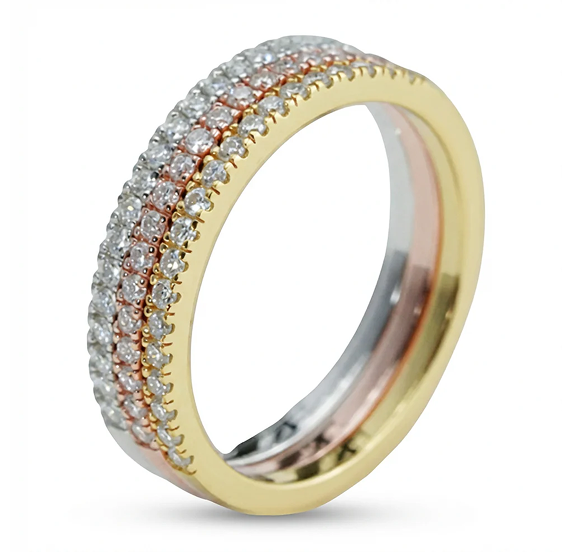
It's one of the most overlooked decisions in buying jewellery — and one of the most important. The metal you choose affects how a piece looks, how long it lasts, and how it feels to wear every day. Here's how to think about it.
Why Metal Matters More Than You Think
Most people spend a long time choosing a stone and almost no time choosing a metal. But the two are inseparable. The metal determines the colour temperature of the whole piece — whether it sits warm or cool against your skin, whether it makes a diamond look icy or rich, whether it reads as contemporary or classic.
It also determines durability. Not all metals wear the same way, and the right choice depends less on what's fashionable and more on how you actually live. The good news: at Mara & Co, all three of our metals — 925 sterling silver, 14 carat gold, and 18 carat gold — are made to last. The question is which one is made for you.
"The right metal isn't the most expensive one — it's the one that suits how you actually live. A piece worn every day in 14ct gold will always outshine a piece kept for best in 18ct."
A Quick Note on Gold Standards in the UK and Beyond
In the UK, the two most common gold hallmarks are 9ct (37.5% pure gold) and 18ct (75% pure gold). They're what most high street jewellers stock, and what most British buyers have grown up seeing.
In the US and across much of Europe, the standard shifts. 10ct and 14ct are far more widely used — 14ct in particular sits at 58.3% pure gold and has become the benchmark for quality jewellery across North America and continental Europe. It's the sweet spot: meaningfully purer than 9ct, more hardwearing than 18ct, and the preferred choice of many of the world's most respected jewellers.
At Mara & Co, we made a deliberate choice to work with 14ct gold over 9ct. It gives our pieces a richer colour, a higher purity, and a finish that holds its own — without the softness of 18ct that makes it less suitable for everyday rings and pieces that take a knock.